
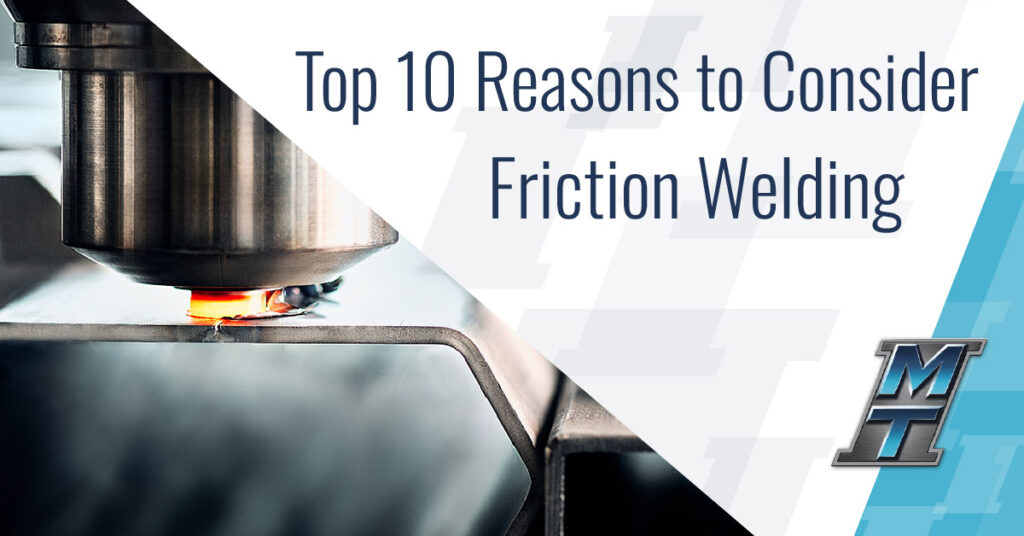
What is Friction Welding?
Friction welding is a truly innovative process. In fact, it is not really welding at all, but actually a forging process that uses force and motion to create a solid-state bond. Friction welding offers a number of joining and welding solutions that can help you make smart design decisions.
The Process of Friction Welding
As a solid-state welding process, friction welding creates heat through controlled motion and forging pressure rather than melting the base materials. This allows components to join with high bond quality and strong mechanical properties, without filler wire or additional materials.
Advantages of Friction Welding
At MTI, we’re opening up all-new possibilities when it comes to solving tough engineering challenges. Wondering if friction welding can meet your demands? Here are ten great reasons to consider it:
- Friction welding allows dissimilar metals to be joined — including some combinations that are otherwise considered incompatible or unweldable.
- The process is at least twice— and up to 100 times—as fast as traditional fusion welding techniques.
- Friction welding machinery is versatile enough to join a wide range of part geometries, materials, and sizes.
- Joint preparation techniques are less critical. That’s because machined, saw cut, and even sheared surfaces are weldable with friction processes.
- Resulting joints are of forged quality, with a 100% butt joint weld through the contact area.
- The machine-controlled process eliminates human error, and the resulting weld quality is the same no matter what the skill or experience level of the operator is. So your results are consistent.
- Friction welding is environmentally friendly! No smoke, fumes, or gases are emitted, and no exhaust systems are required.
- No consumables are used. No flux, no filler material, no shielding gases.
- Power requirements are as low as 20% of those required by conventional welding processes.
- Materials aren’t melted through the friction welding process. That means there are no solidification defects — like gas porosity, segregation, or slag inclusions — in the end product.
What are the Types of Friction Welding?
Friction welding is used across a wide range of industrial applications where strength, durability, repeatability, and material performance are critical. Common friction welding technologies include:
Friction Stir Welding: Friction Stir Welding (FSW) is often used to create strong, watertight welds across surfaces for rail, aerospace, electric vehicle, and marine applications. The process uses a rotating tool to generate frictional heat and stir materials together along the joint line.
Low Force Friction Welding: Low Force Friction Welding uses biased heating to reduce the pressure required to form the weld. This makes the process especially useful for thin-walled parts, complex components, and applications with unique geometries or material limitations.
Rotary Friction Welding: Rotary Friction Welding (RFW) is commonly used for joining round or cylindrical components. It also allows dissimilar metals to be joined without filler material, making it a valuable process for parts that need the combined advantages of two different materials.
Linear Friction Welding: Linear Friction Welding (LFW) can produce a full butt-joint weld with exceptional strength. In many applications, friction welds are known to be as strong as, or stronger than, the base materials. The 100% butt-joint weld prevents structural failure under heavy loads, high pressure, or severe fatigue.
Put Us to the Test
Need to join aluminum to steel? Or copper to aluminum? MTI can do that, and more. Need a 50-foot-long weld along an aluminum panel? Working with uniquely complex part geometries? We can pull that off, too — from automobiles to rocket boosters, and beyond.
In fact, we’ll make your part, build a machine to make your part, or help you make your part even better. Just let us know what you need, and we’ll help determine the best solution for you.
To learn more about friction welding, visit our website or watch how friction welding can be put to work for you.
LinkedIn: https://www.linkedin.com/company/manufacturing-technology-inc
YouTube: https://www.youtube.com/c/ManufacturingTechnologyIncMTIJoiningSolutions/videos