
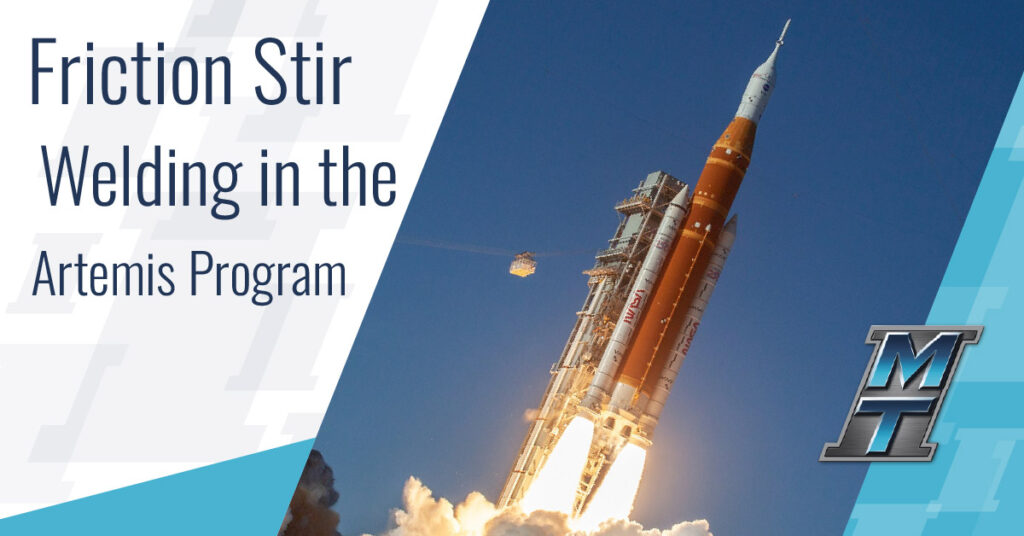
For decades, MTI has helped advance the friction welding technologies behind some of the world’s most demanding aerospace programs. Today, that legacy continues with NASA’s Artemis program through Friction Stir Welding (FSW). In 2008, the Vertical Weld Tool (VWT) Friction Stir Welder joined MTI’s product and technology portfolio. This solid-state welding technology now supports the propulsion systems, helping power NASA’s Space Launch System and Orion toward deep-space missions.
Does NASA Use Friction Welding in the Artemis Program?
Yes. NASA relies heavily on Friction Stir Welding to support the Space Launch System (SLS) and Orion spacecraft used in the Artemis program. Earlier space vehicle manufacturing relied more heavily on traditional fusion welding, but as solid-state welding technologies advanced, NASA adopted Friction Stir Welding for its ability to reduce weld defects such as porosity and hot cracking. Furthermore, NASA’s Friction Stir Welding technology supports structural integrity and lightweight construction.
Friction Stir Welding uses a rotating tool to generate heat through friction along the weld line. Instead of melting the base materials, the process plasticizes and mixes them, creating a strong solid-state weld. This makes FSW a valuable technology for joining large aerospace structures where weld development, heat generation, rotational speed, and process control are critical.
For Artemis, Friction Stir Welding helps join plates and assemblies into larger structural components used in NASA’s launch and spacecraft systems.
Why Friction Stir Welding is Used for Artemis
The Artemis program uses Friction Stir Welding because it supports the strength, consistency, and lightweighting required for advanced spaceflight systems. Key advantages include:
- Reduced Payload Weight: Friction Stir Welding joins parent materials without filler metals, reducing unnecessary weight in aerospace structures where every pound matters. For deep-space systems, this lightweighting advantage supports stronger performance without adding materials that can increase mass or complicate the weld.
- No Melting of Base Materials: As a solid-state welding process, FSW joins metals without melting them. This helps 2000 and 7000 series aerospace aluminum alloys maintain strong mechanical properties while reducing common fusion-welding defects.
- High-Integrity Weld Joints: By preserving material integrity, Friction Stir Weld joints can support the hermetic sealing, structural strength, and reliability needed for components exposed to cryogenic propellants, launch vibration, and demanding spaceflight conditions.
- Repeatable, Machine-Controlled Quality: Friction Stir Welding delivers the repeatability mission-critical assembly requires. With fully automated robotic tooling, NASA can control rotational speed, heat generation, tool movement, and weld development with high consistency.
- Support for Human-Rated Missions: Its machine-driven precision helps produce welds that meet the strict quality requirements of human-rated Artemis missions, including future crewed flights.
Key Friction Welding Applications in Artemis Hardware
With its strength, repeatability, and solid-state joining advantages, Friction Stir Welding plays an important role in critical Artemis hardware. Below are key primary structures assembled across the SLS launch vehicle and Orion crew capsule.
SLS Core Stage and Liquid Fuel Tanks
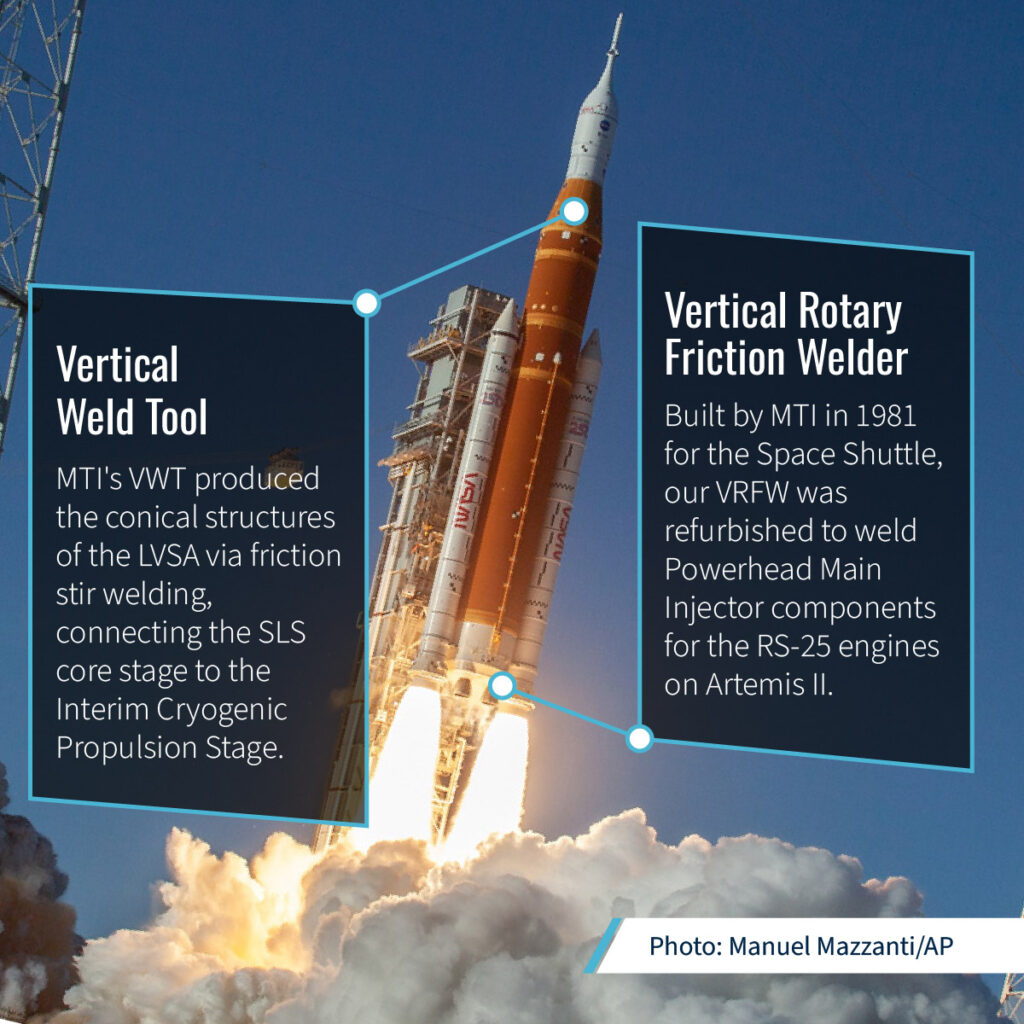
The SLS core stage includes large cryogenic fuel tank structures that require high-integrity welds for strength, sealing, and performance. Utilizing technology like MTI’s Vertical Weld Tool (VWT), NASA joins aluminum barrel sections, domes, and structural rings using Friction Stir Welding at its Michoud Assembly Facility to meet the structural demands of launch and spaceflight. To accommodate these massive components, the VWT can make 25-foot diameter rocket body sections that are over 25 feet tall, and it streamlines the manufacturing process by offering the capability to mill the edges of the panels prior to welding. (Read more on NASA’s advanced metal joining here)
Orion Spacecraft Crew Module Pressure Vessel
The Orion module pressure vessel is built from machined aluminum panels joined through Friction Stir Welding. These sealed weld joints help create an airtight structure designed to protect astronauts in deep space while supporting zero-leakage performance and structural rigidity during demanding mission conditions, including re-entry loads.
Launch Vehicle and Orion Stage Adapters
Some of the most vital friction welding applications in Artemis involve fabricating the Orion Stage Adapter (OSA) and Launch Vehicle Stage Adapter (LVSA) cone panels. Using MTI’s Vertical Weld Tool (VWT), NASA performs Friction Stir Welding on these massive conical structures. These components are welded to load-bearing structural rings that connect upper-stage propulsion systems to the spacecraft, providing the strength and reliability the Artemis launch architecture requires.
MTI's Legacy of Friction Welding with NASA Beyond FSW
While Friction Stir Welding builds the massive structural components of the SLS, MTI’s spaceflight legacy also relies heavily on Rotary Friction Welding. This history dates back to the 1980s, when MTI joined the powerhead main injector on the Space Shuttle Main Engine (SSME), which was used on all 135 Space Shuttle flights. Today, that legacy continues as MTI inertia-welds the powerhead main injectors for the RS-25 engines. This rotary solid-state welding supports the propulsion systems, helping power NASA’s Space Launch System and Orion toward deep space.
Partner with MTI for Solid-State Aerospace Joining Solutions
Since 1976, MTI has been a global leader in friction welding technology. With more than 800 machines designed and built and over 350 patents, we support contract friction welding needs globally through Friction Stir, Rotary, Linear, and Low Force Friction Welding technologies.
Bring your aerospace welding challenge to MTI today. From joint design and feasibility testing to prototyping and production, our team can help you evaluate your application, validate the right solid-state joining process, and move mission-critical aerospace hardware closer to production.