
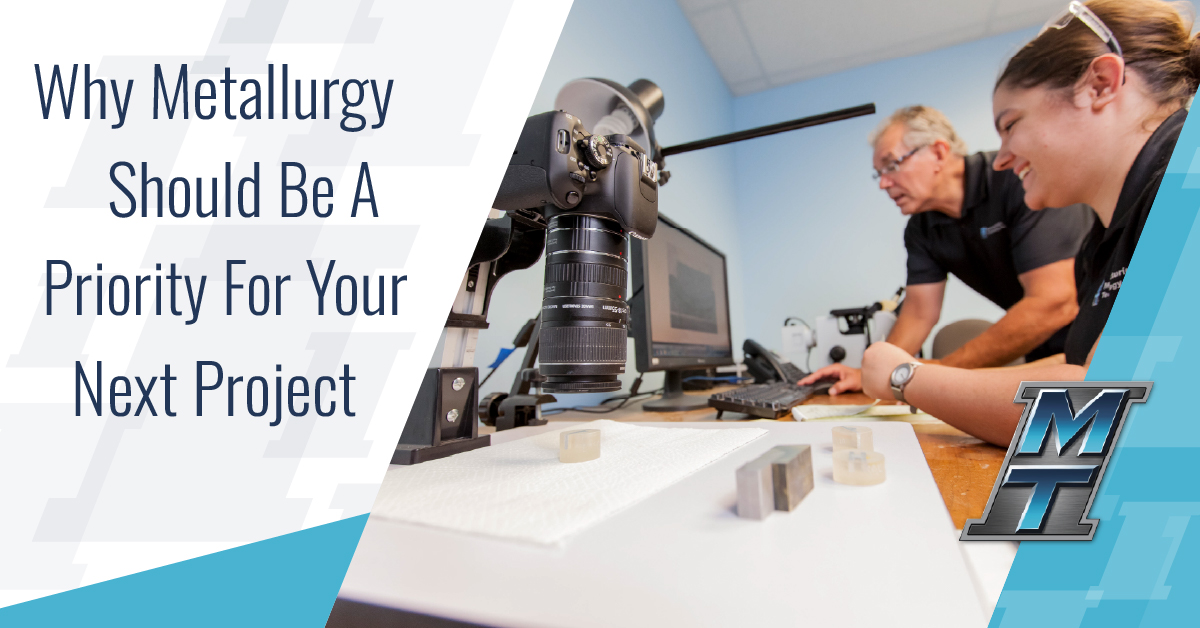
The whir of machines, the beep of a forklift— a manufacturing floor isn’t exactly a place you’d go to find some peace and quiet. But nestled among the hustle and bustle of MTI’s Manufacturing Services building, you’ll find a much quieter place; one that fosters thorough analyses and a methodical evaluation process that’s one part science, one part art.
Unlike many other friction welding companies, MTI has its own, in-house metallurgical lab with offerings in all of our global locations.
Behind the doors of the lab, just feet away from a cluster of friction welding machines, our process engineers use a combination of metallurgical testing equipment before and after friction welding.
But how does a metallurgical lab operate? What purpose does each piece of equipment serve? And why is metallurgy so important to friction welding?
In this blog, we’ll explain why evaluating metals should be a priority, not an option, for your next project.
Metallurgy Defined: The Science Behind Stronger Metal Components
In the simplest of terms, metallurgy is a form of materials science that focuses on the properties of metals and how they interact with one another. Because friction welding almost exclusively joins metal materials, including alloys, it’s easy to understand why we place such an emphasis on metallurgy.
One of the key benefits of friction welding technology is the joining of dissimilar metals, a process that requires deep metallurgical knowledge to execute successfully.
In metallurgical science, there is a lot you can learn about a metal simply by holding it in your hand and examining it with the naked eye, but there is plenty below the surface that requires special tools and knowledge to classify.
At MTI, our process engineers don’t just assume anything. We carefully evaluate every client’s material, even if we have worked with said material before. Each material could have a different geometry or a different application. By taking our time to understand a client’s material, we can establish its parameters.
When Metallurgy Is Used in Project Development
In most cases, a customer defines the stage at which a metallurgical evaluation is required. Their needs also define which tests should be performed to verify material and weld strength. To do that, our process engineers utilize our metallurgical lab to assess the initial welds.
For instance, customers may require an analysis of the initial weld for each production run of a test piece. The process engineer will section a part to get a sample out for a bend test and macro examination.
Bend test? Macro examination? What are those?
We’ll get to that. But first, we need to get our samples ready for testing!
Preparing Materials for Metallurgical Analysis
When MTI’s metallurgy lab examines a part, component, or material before or after welding, the full finished product does not always need to undergo evaluation. In many cases, our metallurgists only need a representative section of the material to begin the metallurgical analysis.
To prepare the sample, the metals are sent to MTI’s machine shop, which is located just steps away from the lab. There, our team can cut each metal to specification, helping streamline the process and keep sample preparation under one roof.
Depending on the evaluation, the metals may also need to be polished or mounted in bakelite before analysis begins. Like every step in MTI’s metallurgy services, the preparation process is guided by the customer’s requirements, the material properties being reviewed, and the type of information needed to support weld development, quality control, or production readiness.
Once the sample is properly prepared, MTI’s engineers can take a closer look at the metal structure, alloy behavior, weld interface, and other critical properties that help determine how the material or welded component is performing.
Types of Quality Tests for Metal Properties
A bend test is one of the most common mechanical quality control tests used in friction welding. This metallurgy test helps MTI evaluate the strength, ductility, and overall performance of welded components after development or production.
While metallurgy lab equipment can be used to perform bend testing, these tests are often completed manually with a wrench and vise, as shown in the clip above. Each part, material, and customer qualification is different, but the goal is typically the same: confirm that the welded sample can bend to a required number of degrees without breaking.
Whether the sample passes cleanly or breaks during the test, MTI’s engineers can then perform a metallurgical analysis under a microscope to identify where the material broke or experienced the highest stress. This level of testing gives customers a clearer understanding of metal properties, alloy compositions, and weld performance before moving forward.
If the sample breaks at the weld interface during the bend test, MTI’s process engineers can review the reference materials, evaluate the weld data, and adjust the friction welding process to improve the material’s characteristics at the joint. This level of weld development helps customers better understand how metal properties, alloy compositions, and process parameters affect final part performance.
Similar to a bend test, a tensile (or tension) test is another proven method for evaluating the strength of a completed weld. During testing, a tensile tester stretches the welded sample until it breaks, giving MTI’s engineers a clear view of how the component performs under load.
Once the test is complete, we perform a metallurgical analysis to determine where the fracture occurred. If the break is located at the weld interface, MTI can use that information to support process improvement. If the fracture occurs in one of the base materials instead, it may indicate that the weld has properties superior to those of the surrounding metal.
Together, these processes support advanced metallurgical review, quality control, and stronger development decisions for customers working with steel, iron, alloys, new metals, and critical components across demanding industries. The metallurgy tests allow clients to try different materials and find ones that are sustainable and provide optimal results
Micro Examination for Advanced Metallurgical Review
As its name suggests, a micro examination uses a microscope to evaluate the welded sample at a much higher magnification. During this metallurgical analysis, MTI reviews the sample at 50x magnification or greater to better understand the material structure, weld interface, and overall quality of the completed component.
In most cases, the sample is etched before examination. This step helps reveal key metal properties, such as grain size, flow lines, alloy behavior, and the presence of discontinuities along the weld interface. For friction welding applications, this advanced metallurgical review provides customers with a clearer view of how the process affects the base materials and the final weld.
In MTI’s metallurgy lab, the microscope is attached to a camera, also known as a metallograph. This equipment allows us to further analyze the material structure, review specific phases of the metal alloy, and document findings that support weld development, quality control, and production readiness.
For customers working with steels, iron, alloys, new materials, or critical components across demanding industries, micro examination provides the science-backed insight needed to make confident decisions before moving forward.
Macro Examination for Material and Weld Development
A macro examination involves reviewing the material structure at low magnification or, in some cases, without magnification. This type of metallurgical analysis gives MTI’s process engineers a broader view of the welded component, helping them evaluate weld formation, material flow, and the overall condition of the joint.
Before a macro examination, the sample is typically polished and etched. This preparation helps reveal important metal properties, including weld shape, bonding characteristics, flow lines, and any visible discontinuities that may affect quality control or future production decisions.
For friction welding applications, macro examination plays an important role in weld development. It allows MTI to review how the process is performing across the full weld area and determine whether adjustments are needed to improve strength, consistency, or repeatability.
Hardness Testing for Strength and Performance Properties
Another key indicator of material strength is hardness, which is defined as a material’s ability to resist permanent indentation. For friction welding applications, hardness testing helps MTI evaluate how the welding process, heat treatment, alloy compositions, and base materials may influence the final properties of a welded component.
In MTI’s metallurgical lab, samples can be evaluated using a Rockwell Hardness Tester or a Microhardness Tester. These quality control tools give our metallurgists a closer look at material performance, supporting weld development, metallurgical analysis, and production readiness for customers working with steels, iron, alloys, and other advanced materials.
On the Microhardness Tester, MTI can perform Knoop or Vickers Hardness Tests at a range of different loads. The metallurgical lab machine uses a diamond indenter to create precise indentations in the material. Depending on the load and material hardness, measurements may be taken very close together, such as 0.005 inches apart.
Indentations on the Rockwell Hardness Tester are made with a greater load. As a result, they must be spaced farther apart. The required spacing depends on the Rockwell scale being used and the hardness of the metal being tested.
By measuring hardness at the appropriate locations, MTI’s engineers can better understand metal properties, identify changes near the weld interface, and confirm whether the process meets the customer’s strength and performance requirements.
Why Metallurgy Should Be a Priority for Your Next Project
By now, you likely understand the power of metallurgy and the value it can bring to a friction welding project.
Choosing a friction welding provider with an in-house metallurgy lab not only provides you with greater material insight but can also significantly reduce lead times and shipping costs by eliminating the need to send samples to outside labs.
Contact us today to begin your development work or to learn more about our metallurgical process.