
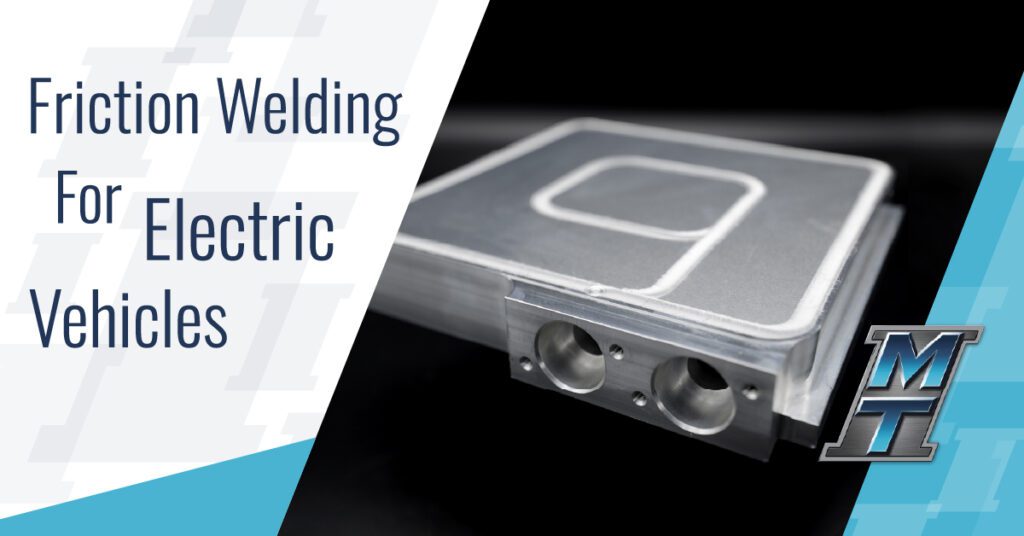
Long before the word “Tesla” spurred any thoughts beyond the iconic inventor of the 1800s, companies around the world were relying on Friction Welding to join their parts. But just as automotive technology has shifted throughout the decades, Friction Welding has followed right along, aligning with the demands of the modern consumer and commercial vehicle market.
As electric vehicles continue to capture a larger share of annual automotive sales across Europe and the United States, new opportunities are emerging for companies that support the auto industry.
In Europe specifically, there’s been an even bigger push to go electric from automotive giants such as BMW, Daimler, Audi, and Volkswagen.
MTI has been Friction Weldingtraditional auto parts for decades — everything from pistons to engine valves. Our proven process is a top choice for leading companies because of, among many things, the increased joint strength and cycle times that Friction Welding provides.
And though we will continue to join these parts, we’re also exploring how Friction Welding can benefit electric vehicles.
How Electric Vehicles Can Benefit From Friction Welding Technology
Friction Welding is a solid-state joining process in which two materials are plasticized through frictional heat and bonded under controlled force. Because the materials are joined without reaching their melting point, the result is a stronger, more reliable weld with fewer metallurgical defects and minimal distortion.
For electric vehicle manufacturers, this advanced technology delivers the structural integrity and repeatability required for high-performance components. By leveraging Friction Welding, EV producers can manufacture durable, efficient, and environmentally responsible vehicles.
Lighweighting
One of the biggest selling points for an electric vehicle is its operating range. In other words, the number of miles it can travel before needing a recharge.
A heavier car can’t travel quite as far, so that’s why many EV manufacturers place such a strong emphasis on lightweighting. Even before the rise of electric vehicles, MTI has helped customers across multiple industries achieve lighter parts. How? Through Friction Welding.
Friction Welding enables us to join dissimilar metals, a substantial advantage for lightweighting. Instead of using a single metal throughout the part, manufacturers could switch to a lighter material for less critical portions and use a heavier material only for the heavy-duty portion.
Some of the most popular combinations include Copper and Aluminum and Steel and Aluminum for welding on electric vehicles.
Superior Structural Integrity
Unlike traditional fusion welding methods, Friction Welding does not melt the base materials. Instead, heat is precisely generated and localized at the joint interface, creating a small heat-affected zone that preserves the original microstructure and mechanical properties of the surrounding material.
By eliminating melting from the process, Friction Welding significantly reduces the risk of common weld defects such as porosity, cracking, and solidification flaws. The result is a cleaner, stronger bond engineered for long-term performance.
This level of structural integrity makes Friction Welding the optimal choice for components subjected to high loads and cyclic stress. From coil springs and crankshafts to chassis frames and other critical automotive parts, manufacturers can rely on consistent, high-strength joints that perform under demanding operating conditions—without compromise.
Minimized Post-Welding Processes
With significantly reduced thermal input, Friction Welding produces joints with minimal distortion and lower residual stress compared to traditional fusion welding methods. The result is a cleaner, more precise bond that often requires less secondary machining, straightening, or corrective processing.
For electric vehicle manufacturers, that efficiency translates directly to measurable savings. By minimizing post-welding operations, organizations can reduce downstream processing costs.
Filler or Flux Not Required
As a true solid-state joining process, Friction Welding eliminates the need for filler metals or flux. By generating heat through friction rather than an external heat source, the process minimizes thermal distortion while preserving part geometry and material properties.
Without consumables introduced into the joint, manufacturers gain greater process consistency, improved part integrity, and fewer variables to control on the production floor. This streamlined approach reduces material costs and simplifies automation.
For EV manufacturers committed to efficiency and sustainability, Friction Welding supports cleaner operations, reduced waste, and dependable, repeatable results. It helps them support their goals in evolving the clean-energy automotive market.
Repeatable and Programmable Friction Welders
Modern electric vehicle production demands precision, consistency, and automation at scale. MTI’s friction welding machines are engineered with programmable controls to deliver exactly that.
With automated systems operating from validated, repeatable welding parameters, each cycle follows a predetermined process designed to produce high-quality electric vehicle components. This level of repeatability reduces operator dependency, lowers labor costs, and minimizes variability across production runs.
Friction Welding Applications
Friction Welding offers more than just structural strength and lightweighting. It’s a versatile solution designed to meet the high-performance demands of today’s electric vehicles and hybrid vehicles. In fact, Friction Welding machines are the standard tools for sensitive electronics.
For EV manufacturers, the applications of friction stir welding are extensive, supporting the development of safer, more efficient, and longer-lasting vehicles. Common FSW applications in the automotive industry include:
- Battery trays
- Heat exchangers
- Inverter housings
- Mounting brackets
- Electronic enclosures
Friction Welding Technologies That the EV Industry Can Benefit From
Additionally, while gas-powered and electric vehicle manufacturers certainly have different needs and priorities, both seek to produce their products as quickly and efficiently as possible. This is where different Friction Welding technologies come in:
Friction Stir Welding (FSW)
Friction Stir Welding creates airtight and watertight seals. This solid-state process is critical when protecting sensitive electronics and battery components from moisture, dust, and debris.
FSW uses a rotating non-consumable pin tool that moves along the joint line. The heat generated by friction softens the materials without melting them, allowing them to be forged together at the molecular level under pressure.
FSW machines are commonly used to join aluminum plates, extrusions, and sheets found in battery trays, enclosures, and structural components of electric vehicles. See our FSW contracting services to explore possibilities for your prototyping and manufacturing.
Rotary Friction Welding
Rotary Friction Welding (RFW) generates heat by rotating one component against a stationary counterpart under controlled pressure. The resulting frictional heat plasticizes the materials at the interface, creating a high-strength, solid-state bond without melting the base metals.
This proven process is widely used across demanding automotive applications, including bimetallic exhaust valves, driveshafts, battery components, and other critical EV assemblies.
For prototyping or manufacturing these parts, MTI’s RFW machines are engineered to deliver consistent performance, scalable output, and exceptional weld quality.
Low Force Friction Welding
Low Force Friction Welding enhances traditional friction welding by introducing an external energy source to raise the interface temperature before forging. By reducing the force required to achieve a solid-state bond, Low Force delivers a more controlled, efficient joining process.
The advantages of Low Force machines are significant. Manufacturers benefit from reduced flash, lower mechanical loads, and a smaller machine footprint, all while maintaining the strength and consistency expected from solid-state joining. For electric vehicle production environments where space, throughput, and automation matter, these efficiencies translate directly to operational gains.
Low Force is particularly well-suited for high-demand EV applications such as electric axles (eAxles), where faster production cycles are essential to keep pace with the rapidly expanding electric vehicle market. In one automotive program, cycle times improved by up to 32%.
Contract Friction Stir Welding Services For Electric Vehicle Production
As a global friction stir welding service provider for automotive applications, MTI offers Friction Welding contract services tailored to the needs of the e-mobility sector. Whether you’re developing a new component or scaling up production, our contract welding services deliver high-precision, repeatable welds ideal for electric vehicles, hybrid vehicles, and beyond. With MTI, you’re not just getting access to advanced technology; you’re gaining a strategic partner.
As a metal friction-welding provider for automotive parts, our pre- and post-welding capabilities ensure a complete solution under one roof. We manage the full process so you can move from concept to completion with confidence and efficiency.
Ready to explore how Friction Welding can benefit your electric vehicle application? Click here to begin the conversation with one of our knowledgeable sales engineers!
Discover how our FSW contract services improved EV production for Rivian Automotive, Inc. in this case study.
About MTI
MTI has established itself as a global leader in Friction Welding, including Rotary, Linear, Low Force, and Friction Stir Welding technologies. In addition to contract manufacturing services, MTI has delivered machines to Daimler, DAF, Dana, BWI, GE, Rolls- Royce, Pratt and Whitney, Federal Mogul, and many of their tier one suppliers. A family-owned business founded in 1926, MTI employs over 200 people worldwide.